
Injectable Medications (BOTOX®) For Overactive Bladder (OAB)
Advanced Urology Associates treats Overactive Bladder (OAB) patients with injectable BOTOX® medication. BOTOX® helps treat adults with the Overactive Bladder symptoms of leaking, having to go too often, and the strong sudden need to go.

What is BOTOX® for OAB?
 BOTOX® is a prescription medicine that is injected into the bladder muscle and approved to treat overactive bladder symptoms such as a strong need to urinate with leakage or wetting accidents (urge urinary incontinence) a strong urge to urinate right away (urgency) and urinating often (frequency) in adults 18 years and older when another type of medication (anticholinergic) does not work well enough or cannot be taken.
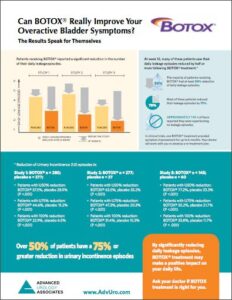
Patients receiving BOTOX® reported a significant reduction in the number of their daily leakage episodes.
How Does BOTOX® Treatment Work?
BOTOX® treatment works by calming the nerves that trigger the overactive bladder muscle. In your body, certain chemicals travel from nerve cells to muscle cells to make your bladder contract so that you can urinate. With OAB, these muscles contract uncontrollably, creating leakage, the strong sudden need to go, and going too often.
BOTOX® is injected into the bladder muscle and works on the nerve to help block the signals that trigger OAB, which helps:
- Reduce daily leakage episodes.
- Treat the strong need to urinate right away.
- Reduce the number of times that you need to empty your bladder daily.
When Can I Expect to See Results?
How Long Does BOTOX® Last?
- You are young and may consider have children one day
- You are being pressured by your spouse or partner
- You are in an unstable relationship or not married
- You are depressed, stressed, or have difficulty making important life decisions
- You are planning to change your mind and reverse it later
Reversing a vasectomy can be complex and success can be variable, so make absolutely sure that you have considered all of these options.
When Should I Consider BOTOX® as Treatment?
BOTOX® is a different type of treatment option to consider when another type of medication (anticholinergic) does not work well enough or cannot be taken. The American Urological Association (AUA) treatment guidelines list BOTOX® as an appropriate therapy to consider discussing with your doctor when:
- Self-management is not effective.
- Anticholinergic medications do not work well enough or are too difficult to tolerate.
How are BOTOX® Treatments Administered?
Once you and your doctor decide that BOTOX® is right for you, very often it can be administered in your Urologist’s office.
Before your treatment day:
- Your doctor will prescribe an antibiotic to prevent against a urinary tract infection.
- The week prior to your procedure your doctor will order a urine culture to ensure you do not have an infection.
On the treatment day:
- Your doctor will numb your bladder for a more comfortable treatment.
- Once your bladder is numb, a small lighted tube called a cystoscope will be inserted through the urethra (the natural opening where the urine comes out).
- BOTOX® is injected through the cystoscope into multiple areas of your bladder muscle.
- The entire process takes approximately one hour: 30 minutes to prepare and administer the BOTOX® and 30 minutes for post-procedure evaluation.
After treatment:
- You will be scheduled for a follow up visit after your procedure for a post void residual to ensure you are emptying your bladder.
Are BOTOX® Treatments Painful?
Are There Risks or Side Effects of BOTOX® Treatments
BOTOX® Treatment Facts
- The U.S. Food and Drug Administration has approved a new use for BOTOX® (onabotulinumtoxinA) to treat overactive bladder symptoms such as a strong need to urinate with leakage, urgency and frequency in adults when another type of medicine (anticholinergic) does not work well enough or cannot be taken. 1
- The availability of BOTOX® for the treatment of overactive bladder is important news for those who have tried other medications but still experience urge urinary incontinence – or leakage from the bladder.
- An estimated 14.7 million adults in the United States experience symptoms of OAB with urinary incontinence.2 Many people with OAB are prescribed anticholinergic medications, which are typically prescribed as pills, to manage their condition.3 It is estimated, however, that greater than 50 percent of these patients stop taking at least one oral medication within 12 months, likely due to an inadequate response to, or intolerance of, the medication.4
- For those patients who have not found adequate relief or can’t tolerate the side effects after taking an anticholinergic medicine, BOTOX® may be a treatment option. BOTOX® calms muscle contractions by temporarily blocking the transmission of nerve impulses to the bladder muscle.
- In two clinical studies, the safety and efficacy of BOTOX® (onabotulinumtoxinA) was evaluated in patients with overactive bladder whose symptoms were not adequately managed with anticholinergic medications, which are commonly prescribed as pills. BOTOX® reduced daily frequency of urinary leakage episodes from baseline by approximately 50% or more by week 12 compared to placebo (reduction of 2.5 episodes from baseline of 5.5 episodes in study 1 and reduction of 3 episodes from baseline of 5.5 episodes in study 2 for those treated with BOTOX® vs. a reduction of 0.9 episodes from a baseline of 5.1 episodes in study 1 and a reduction of 1.1 episodes from a baseline of 5.7 episodes in study 2 for those treated with placebo).1
- The efficacy of BOTOX® at reducing urinary leakage and other symptoms of overactive bladder was up to 6 months duration. The median duration of response in study 1 and study 2, based on patient qualification for retreatment, was 135-168 days for the BOTOX® 100 unit dose group compared to 88-92 days for placebo. To qualify for retreatment, at least 12 weeks must have passed since prior treatment, post void residual urine volume must have been less than 200 mL and patients must have reported at least two urinary incontinence episodes over three days.1
- Improvements in other symptoms of overactive bladder, daily frequency of urination and the amount of urine voided, also occurred with BOTOX® treatment compared to placebo at week 12.1
- The most common side effects reported with BOTOX® treatment in the clinical studies included: urinary tract infection (18%, vs. 6% with placebo), dysuria (9%, vs. 7% with placebo), which means painful or difficult urination; and urinary retention (6%, vs. 0% with placebo), which is a temporary inability to fully empty the bladder requiring clean intermittent catheterization.1 Clean intermittent catheterization is a way to manage incomplete bladder emptying.5 The patient will only need to insert the catheter when they need to drain urine and then remove it after use. Patients with diabetes mellitus treated with BOTOX® were more likely to develop urinary retention than non-diabetics. As with any medical treatment, it’s important to talk to your doctor about all the potential side effects as well as benefits, to evaluate if BOTOX® might be an option for you.
Contact the urologist doctors at Advanced Urology Associates for more information on BOTOX for Overactive Bladder (OAB) treatments. Give us a call at: (815) 409-4930
1 BOTOX® (onabotulinumtoxinA) Prescribing Information, updated January 2013.
2 Stewart WF, Van Rooyen JB, Cundiff GW, et al. Prevalence and burden of overactive bladder in the United States. World J Urol 2003:20:327-336; based on 2010 U.S. Census data and U.S. adult population [as of Jan 10, 2013].
3 National Patient Count, IMS Total Patient Tracker, USC 24100, MAT 11/12.
4 D’Souza et al. Persistence, Adherence, and Switch Rates Among Extended-Release and Immediate-Release Overactive Bladder Medications in a Regional Managed Care Plan. J. Managed Care Pharm. 2008;14(3):291-301
5 Wyndaele JJ, et al. Neurourol Urodyn. 2010;29(4):662-669.
Advanced Urology treats overactive bladders in patients from Aurora, Bolingbrook, Chicago, Crest Hill, Elk Grove Village, Elmhurst, Frankfort, Homer Glen, Joliet, Lombard, Lockport, New Lenox, Mokena, Morris, Naperville, Orland Park, Park Ridge, Plainfield, Tinley Park and Woodridge, Illinois.